

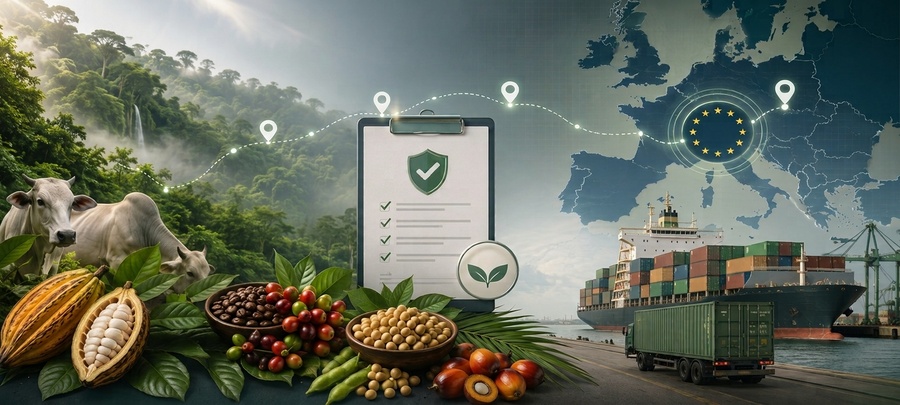
For food companies selling cocoa, coffee, beef, soy or palm oil into Europe, 30 December 2026 is becoming one of the most important regulatory dates of the year.
That is when the European Union Deforestation Regulation — better known as the EUDR — starts applying to large and medium-sized operators. Most micro and small operators have until 30 June 2027, while micro and small operators already covered by the EU Timber Regulation must comply from December 2026.
The legislation is designed to prevent products associated with deforestation and forest degradation from entering or leaving the EU market.
For food exporters outside Europe, however, the EUDR is about much more than another EU environmental rule.
European importers will increasingly need detailed information about where products came from, where the raw materials were grown or raised, and whether those supply chains can demonstrate compliance.
Suppliers who can provide that information efficiently may find themselves in a much stronger position when approaching European buyers.
So what exactly changes in December, which food products are affected and what should exporters be doing now?
What is the EUDR?
The EU Deforestation Regulation, Regulation (EU) 2023/1115, aims to ensure that certain commodities and products sold in or exported from the European Union are not associated with recent deforestation or forest degradation.
The regulation covers seven commodities:
- cattle
- cocoa
- coffee
- oil palm
- rubber
- soy
- wood
For the food industry, cattle, cocoa, coffee, palm oil and soy are particularly important.
The regulation also applies to specified products derived from these commodities. Examples can include beef and certain meat products, chocolate and cocoa preparations, coffee products, soybean products and palm-oil derivatives.
However, exporters should not assume that every food containing cocoa, soy or palm oil automatically falls under the regulation. The exact CN/HS classification listed in Annex I of the EUDR determines whether a product is covered.
This makes checking the customs classification of your products one of the first steps in preparing for EUDR.
The EUDR deadline is now 30 December 2026
The EUDR timetable has changed several times, which explains why exporters may still encounter older deadlines online.
Following amendments adopted in December 2024 and December 2025, the current timetable is:
30 December 2026: large and medium-sized operators must comply.
30 December 2026: micro and small operators already covered by the EU Timber Regulation must also comply.
30 June 2027: most other micro and small operators must comply.
The additional time does not mean businesses should postpone preparation.
European importers are already working with suppliers to collect the information they will need once the regulation applies.
For exporters, that makes 2026 a preparation year — and increasingly a buyer-qualification year as well.
The three conditions products must satisfy
At its core, the EUDR requires relevant products to meet three main conditions before they can be placed on the EU market.
They must be:
- Deforestation-free
- Produced in accordance with the relevant legislation of the country of production
- Covered by the required due diligence documentation
For the deforestation requirement, the key cut-off date is 31 December 2020. Relevant products cannot originate from land that has been subject to prohibited deforestation after that date.
The legality requirement goes further than simply proving ownership of the crop. Relevant legislation can involve issues such as land-use rights, environmental rules, labour rights, tax and customs legislation and certain rights of Indigenous Peoples.
For many exporters, however, the most significant operational change will be traceability.
Geolocation becomes a critical part of food traceability
EU operators carrying out EUDR due diligence must collect information on the origin of the commodities involved.
One of the most important requirements is the geolocation of the plots of land where the relevant commodity was produced.
The information required can include:
- the country of production
- the relevant production area
- geolocation of the plots of land
- date or time range of production
- product description and quantity
- supplier information
- evidence that the product is deforestation-free
- evidence that production complied with applicable local legislation
Where commodities included in a product originate from multiple plots, the relevant plots must be traceable. For cattle products, traceability requirements relate to the establishments where the animals were kept.
This is why EUDR compliance can become particularly complex in fragmented agricultural supply chains involving hundreds or thousands of small farms.
It is no longer enough for a supplier to say that cocoa came from Côte d’Ivoire, coffee came from Brazil or soy came from a particular region.
The EU operator may need information that takes traceability much closer to farm level.
What does this mean for exporters outside the EU?
An important distinction is that a producer or exporter located outside the European Union will not necessarily be the company legally responsible for submitting the EUDR due diligence statement.
In many import transactions, the European company placing the product on the EU market will be the operator responsible for EUDR compliance.
But that operator cannot perform its due diligence without information from its suppliers.
The European Commission specifically notes that smallholders outside the EU who do not themselves place products on the EU market may nevertheless be asked by buyers for information such as the geolocation of the plots where their commodities were produced.
In practice, this means European food importers are likely to ask exporters questions such as:
Can you identify the farms or plots where the commodity originated?
Can you provide geolocation data?
Can you demonstrate that the land has not been deforested since the EUDR cut-off date?
Can you provide documents showing compliance with local laws?
Can every shipment be traced back through your supply chain?
Can you prevent compliant material from being mixed with material of unknown origin?
The ability to answer those questions could increasingly influence which suppliers EU importers choose to work with.
Certification alone may not be enough
Exporters should also be careful about assuming that an existing sustainability certification automatically guarantees EUDR compliance.
Certification and third-party verification can help provide evidence, but they do not replace the operator’s EUDR due diligence responsibilities.
This becomes particularly important with supply-chain systems based on mass balance, where compliant or certified material can be mixed with material of unknown origin.
European Commission guidance makes clear that mixing known-origin material with unknown-origin material is not acceptable for demonstrating EUDR compliance. The relevant product must be traceable and the necessary information must be available for the commodities involved.
For exporters, therefore, traceability systems may need to go further than those used simply to support sustainability labels.
Low-risk countries are not exempt
The EUDR also introduced a benchmarking system that classifies countries as low, standard or high risk.
The current high-risk countries are:
- Belarus
- Democratic People’s Republic of Korea
- Myanmar
- Russian Federation
Countries not classified as either low or high risk are treated as standard risk. A large group of countries has been designated low risk.
This classification matters because operators sourcing entirely from low-risk countries can use simplified due diligence.
But simplified does not mean exempt.
Operators still need to collect the basic information required under the EUDR, including relevant origin and traceability information. What changes is that, under the simplified procedure, they generally do not need to carry out the full risk-assessment and risk-mitigation stages unless information indicates a risk.
An exporter therefore should not tell an EU buyer: “Our country is low risk, so we don’t need EUDR documentation.”
A much stronger commercial response is: “Our country is classified as low risk and we already have the traceability information your company will need for simplified due diligence.”
That difference may become increasingly important in supplier selection.
The rules were simplified in 2025 — but traceability still matters
The revised EUDR adopted in December 2025 also reduced some of the administrative burden originally expected further down the supply chain.
Under the amended system, the main responsibility for carrying out due diligence and submitting the due diligence statement rests with the operator first placing the relevant product on the EU market or exporting it.
Downstream operators and traders generally no longer need to submit a new due diligence statement for every step in the supply chain. Instead, their obligations focus more heavily on maintaining the required traceability information, while non-SME downstream actors must also register in the EUDR Information System.
This makes the regulation less administratively burdensome than earlier versions suggested.
It does not, however, remove the need for reliable information at the beginning of the supply chain.
For an EU importer, poor data from an overseas supplier can still become an EUDR problem.
New changes to the products covered by EUDR
The regulation is also continuing to evolve.
On 13 July 2026, the European Commission adopted an update to the list of products covered by the EUDR.
Among other changes, the Commission proposed removing several products from scope, including certain cattle hides and leather products, while adding soluble coffee, certain palm-oil derivatives and frozen cattle tongues.
The newly added products are intended to become subject to the regulation from 30 December 2027, giving businesses additional preparation time. At the time of the Commission’s July announcement, the Delegated Act was still subject to scrutiny by the European Parliament and Council before entering into force.
For food exporters this reinforces an important point:
Do not rely indefinitely on an old list of EUDR products.
Companies should check the latest version of Annex I and the applicable customs codes when determining whether their products are covered.
Cocoa shows why exporters should prepare early
The cocoa industry provides a useful example of the practical difficulties EUDR can create.
West African cocoa supply chains frequently involve hundreds of thousands of small farmers, making farm mapping, traceability and documentation significantly more complicated than in highly consolidated agricultural industries.
In August 2026, Reuters reported that parts of the West African cocoa sector were still struggling to prepare for the regulation, despite significant investments by some exporters in mapping farms and improving traceability.
The issue matters well beyond West Africa: the region produces roughly 70% of the world’s cocoa, while the EU is a major destination for its exports. Concerns have consequently emerged about the availability and potential premium attached to fully compliant cocoa supplies.
Cocoa may be one of the most visible examples, but similar questions can emerge wherever food commodities move through long, fragmented supply chains.
EUDR could influence which suppliers European importers choose
This is the part of the regulation that exporters should not underestimate.
Compliance is often discussed as a legal problem. For exporters, it can also become a sales issue.
Imagine an importer considering two potential coffee suppliers. Supplier A offers an attractive price but cannot immediately provide reliable farm-level origin data.
Supplier B already has its farms mapped, maintains clear batch traceability and can provide the importer with the documentation needed for EUDR due diligence.
Even if Supplier B is slightly more expensive, it may represent considerably less regulatory and operational risk. The same calculation can apply to cocoa, beef, soy and palm-oil suppliers.
As the deadline approaches, European buyers may increasingly screen potential suppliers not only for:
- price
- product quality
- certifications
- production capacity
- logistics
but also for:
- EUDR readiness
- traceability
- data quality
- speed of documentation
- reliability of origin information
For prepared exporters, this could become a competitive advantage.
What food exporters should do before December 2026
Companies selling affected commodities or products to Europe should use the remaining months to review their export supply chains.
1. Check whether your product is actually covered
Identify the HS/CN code for each product and compare it with the products listed in Annex I of the EUDR.
Do not make decisions based only on ingredients or product names.
2. Map your supply chain
Identify where your cocoa, coffee, cattle, soy or palm oil originates.
For complex sourcing networks, determine how far upstream your current traceability system can go.
3. Start collecting geolocation information
If your European customer will require plot-level data, waiting until an order is ready to ship is far too late to begin collecting it.
Build this information into your supplier-management process now.
4. Confirm the deforestation status of production areas
Your documentation needs to support the requirement that relevant commodities are not associated with prohibited deforestation after 31 December 2020.
5. Review legal-compliance documentation
Determine which documents demonstrate that production complies with relevant legislation in the country of origin.
6. Avoid unknown-origin material entering compliant batches
Review how products are collected, stored, processed and combined.
A traceability system loses much of its value if compliant material becomes mixed with material whose origin cannot be established.
7. Ask European customers what information they expect
Do not assume every importer will manage EUDR data in exactly the same way.
Talk to your customers about the format, frequency and timing of the information they expect from suppliers.
8. Build an EUDR information package for new buyers
For exporters prospecting for European customers, consider preparing a concise EUDR-readiness package covering:
- origin countries
- production areas
- traceability methodology
- geolocation availability
- certification
- compliance controls
- documentation available to importers
Instead of waiting for potential buyers to ask whether you are ready, make your readiness part of the sales proposition.
Non-compliance could be expensive
The regulation gives EU Member States responsibility for establishing and enforcing penalties.
The EUDR requires those penalties to be effective, proportionate and dissuasive. For legal persons, the maximum fine available under national rules must reach at least 4% of total annual EU-wide turnover in the financial year preceding the decision, with the possibility of higher amounts where necessary to remove the economic benefit of the infringement.
Other measures can include confiscation of products or revenues, temporary exclusion from public procurement and, in serious or repeated cases, temporary restrictions on placing relevant products on the market.
For importers, therefore, choosing suppliers that cannot provide reliable EUDR information can represent a genuine commercial risk.
That is another reason exporters should see compliance not simply as paperwork, but as part of their ability to access and retain European customers.
Compliance is only the first step — exporters still need buyers
Becoming EUDR-ready can help keep the European market open to your products. It does not automatically generate sales.
Once exporters have the product, documentation, pricing and logistics in place, the next challenge remains the same: identifying the right importers and distributors to approach.
European food distribution is highly fragmented. The most relevant buyer may be a specialist cocoa importer in the Netherlands, a coffee distributor in Germany, a meat importer in Italy or a food ingredients company serving several EU markets.
Finding those companies individually can require substantial research.
BestFoodImporters helps food producers and exporters search verified importers and distributors across international markets, making it easier to identify potential buyers by country, product category and company profile.
For companies preparing for EUDR, the combination can be particularly powerful:
Become compliant. Identify the right market. Find the right importers. Approach them with a stronger, lower-risk supplier proposition.
The December deadline could also create opportunities
EUDR will undoubtedly add work for many food companies.
But regulatory change also reshapes supply chains.
Some suppliers may struggle to provide sufficient traceability. Some European importers may need to replace existing sources. Buyers may begin searching for alternative suppliers in lower-risk countries or for producers with stronger documentation systems.
The result could be new opportunities for exporters that prepare early.
The question therefore should not only be: “What do we have to do to comply with EUDR?”
A better question may be: “How can we use EUDR readiness to become a more attractive supplier to European food importers?”
With the main 30 December 2026 application date approaching, now is the time to find out.
This article provides general business information and should not be considered legal advice. Companies should consult the latest European Commission guidance and professional advisers to determine how the EUDR applies to their specific products and supply chains
