


The global food trade landscape in 2026 is being reshaped by structural changes rather than short-term fluctuations. Food security strategies, supply chain diversification, geopolitical realignments, retail modernization, and new trade agreements are redefining where opportunities lie for exporters. For companies exporting food products and looking to enter new markets, the most promising destinations are not simply the largest economies. Instead, the strongest opportunities are emerging in markets where recent policy shifts, demographic expansion, retail transformation, or trade liberalization have created new entry points.
Sign-up to discover how our platform can help you reach over 31.000 food importers from around the world.
This report highlights the most attractive food export markets in 2026, focusing on countries where change is creating tangible commercial potential.
Saudi Arabia: Strategic Food Security and Premium Demand
Saudi Arabia remains one of the most structurally import-dependent food markets in the world. Limited agricultural capacity, combined with ambitious economic diversification under Vision 2030, has reinforced the Kingdom’s commitment to long-term food security partnerships.
In 2026, government-backed food security programs continue to support stable import volumes across essential categories such as grains, dairy, poultry, and processed foods. At the same time, a young and increasingly affluent population is driving demand for premium imported brands, functional foods, and high-quality European and Asian products.
Retail infrastructure has modernized rapidly, with large hypermarket groups expanding across major cities and e-commerce penetration accelerating. For exporters, Saudi Arabia offers both volume stability and premium positioning opportunities, provided that regulatory compliance and halal certification standards are carefully managed.
Vietnam: Rapid Retail Expansion and Middle-Class Growth
Vietnam has solidified its position as one of Southeast Asia’s most dynamic food import markets. Strong economic growth, urbanization, and the rapid expansion of the middle class are transforming consumer behavior.
In 2026, modern retail formats continue to expand in Ho Chi Minh City, Hanoi, and secondary urban centers. Consumers are increasingly open to Western-style packaged foods, dairy products, confectionery, and premium beverages. Vietnam’s participation in multiple free trade agreements has also reduced tariffs across a range of categories, making market access more attractive for international suppliers.
For exporters seeking ASEAN exposure, Vietnam offers a balanced combination of growth, regulatory improvement, and rising consumer purchasing power.
Mexico: Retail Consolidation and Diversified Sourcing
Mexico continues to rank among Latin America’s largest food importers, but 2026 presents new structural dynamics. Economic momentum linked to nearshoring trends has strengthened domestic consumption and reinforced the purchasing power of major retail chains.
Retail consolidation has centralized procurement processes, creating opportunities for exporters capable of supplying consistent volumes and competitive private label solutions. At the same time, Mexican consumers are showing increasing interest in differentiated imported products, including specialty cheeses, gourmet ingredients, plant-based alternatives, and international cuisine products.
Mexico’s geographic proximity to the United States and its trade integration with North America make it a strategic platform for exporters targeting the broader region.
India: Selective Liberalization and Premium Import Niches
India remains a complex but increasingly promising destination for food exporters. While protective tariffs continue to apply in many staple categories, selective tariff rationalization and growing demand for premium imports are creating focused entry opportunities.
Urban consumers in Tier-1 and Tier-2 cities are driving demand for high-quality chocolates, dry fruits, specialty dairy products, health foods, and gourmet packaged goods. The expansion of organized retail and online grocery platforms has improved product accessibility for imported brands.
Success in India requires precise market positioning, strong importer partnerships, and careful navigation of regulatory requirements. However, for exporters targeting premium segments, the long-term growth potential is significant.
Nigeria: Structural Demand in Africa’s Largest Consumer Market
Nigeria remains Africa’s most populous country and one of its most structurally import-dependent food markets. Although currency volatility and foreign exchange constraints have affected trade flows in recent years, 2026 shows renewed stabilization efforts.
Urbanization continues at a rapid pace, and modern retail networks are expanding in Lagos and other major cities. Demand for staple imports such as rice, dairy powder, frozen poultry, and tomato paste remains strong, while packaged consumer foods are gaining traction among younger urban consumers.
Exporters entering Nigeria must work closely with experienced local importers to manage regulatory procedures and foreign exchange considerations. For companies able to navigate these complexities, the scale of the market offers considerable long-term potential.
Poland: A Strategic Gateway to Central and Eastern Europe
Poland has strengthened its role as a logistics and distribution hub within the European Union. Its strategic location, developed infrastructure, and competitive cost base make it an attractive gateway to Central and Eastern Europe.
In 2026, Poland continues to experience growth in modern retail and discount chains, while also serving as a re-export platform to neighboring EU markets. Exporters supplying processed foods, frozen products, and ingredients for private label manufacturing can benefit from Poland’s integrated supply networks.
For non-EU exporters seeking entry into the European market, establishing partnerships in Poland can provide broader regional access.
Conclusion: Strategic Expansion in a Reshaped Trade Environment
The most attractive food export markets today are defined not only by size, but by transformation. Countries investing in food security, expanding modern retail infrastructure, liberalizing trade frameworks, or experiencing rapid demographic growth are creating concrete new opportunities for international suppliers.
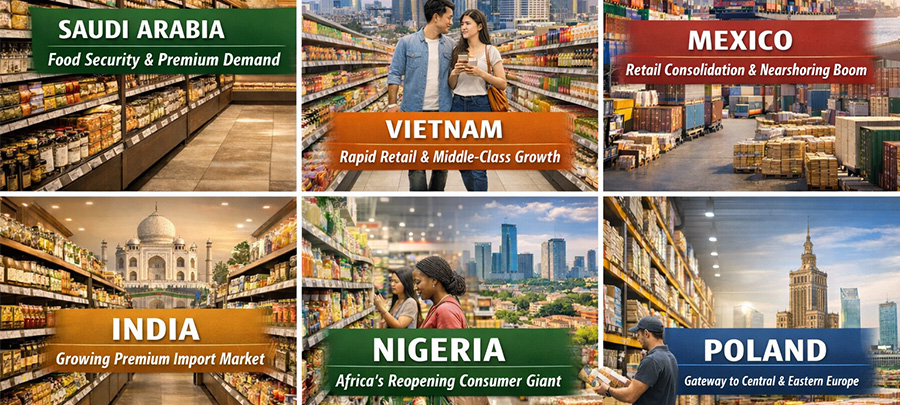
Saudi Arabia offers structural import stability combined with premium demand growth. Vietnam delivers strong economic momentum and expanding middle-class consumption. Mexico benefits from retail consolidation and nearshoring-driven economic strength. India presents selective but expanding premium niches. Nigeria provides scale in a structurally import-dependent environment. Poland serves as a strategic gateway to the wider European Union.
For exporters, success in this evolving environment requires careful market selection, detailed import data analysis, reliable local partnerships, and a clear understanding of regulatory and labeling requirements. Early movers who identify and engage with active importers in these markets will be best positioned to secure long-term distribution relationships.
BestFoodImporters supports this process by providing access to verified food importers, distributors, and buyers across more than 200 countries. Through structured market intelligence and buyer connections, exporters can significantly reduce entry risk and accelerate international expansion.
In a global trade environment increasingly shaped by diversification and resilience, informed market entry decisions are the foundation of sustainable growth.
