

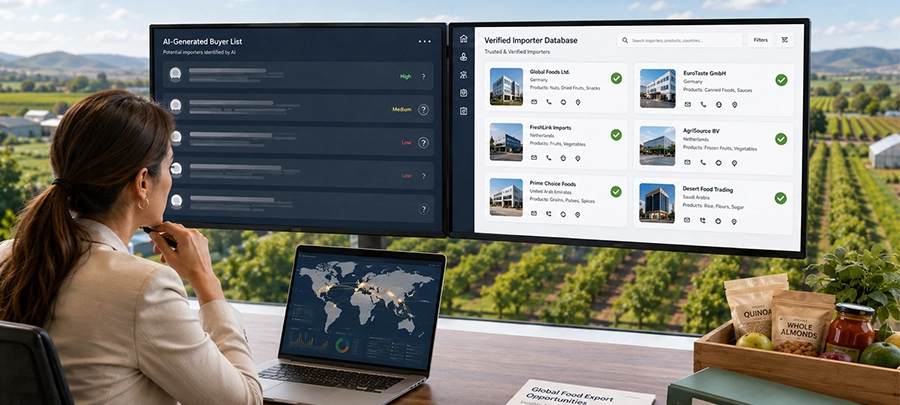
Finding suitable food importers has traditionally required hours of online research, trade-fair preparation, business-directory searches, industry introductions and manual verification.
Generative AI appears to offer a much faster alternative. A food producer can now ask ChatGPT: “Find 40 food importers in Germany and the Netherlands that distribute organic fruit snacks, sell to supermarkets and health-food retailers, and may be open to private-label products.” Within seconds, ChatGPT may produce a structured list of company names, websites and short descriptions. That is considerably faster than searching for companies individually. But speed is only one part of the process.
The more important question is whether those companies are active, relevant and contactable—and whether they are genuinely suitable for the producer’s product, price level, capacity and export strategy.
ChatGPT can be a valuable export-research assistant. It can help producers understand markets, identify possible companies and prepare more relevant communication. However, it is less reliable as the final source of record for company activity, product fit, importing status and decision-maker contact information.
What ChatGPT can do well
Used correctly, ChatGPT can accelerate several important parts of the buyer-search process.
1. Explore potential export markets
Before searching for individual companies, exporters can use AI to develop initial market hypotheses.
For example, a producer can ask:
- Which European markets have growing specialist channels for organic food?
- Which countries are suitable for premium olive oil?
- Where are imported ethnic foods commonly sold through mainstream retail?
- Which markets have strong demand for frozen convenience products?
- What types of distributors usually handle sports-nutrition products?
- Which sales channels are most relevant for premium confectionery?
These answers should not replace formal market research, but they can help an export manager organize the first stage of the analysis.
AI can also compare markets according to factors such as consumer positioning, retail structure, distribution channels and potential regulatory complexity.
2. Define the ideal food importer
One of the strongest uses of AI is helping a producer define what a suitable buyer should look like before searching for company names.
A good importer profile may include:
- Target country or region
- Relevant product category
- Retail, foodservice or industrial focus
- Ambient, chilled or frozen logistics
- Premium, mainstream or value positioning
- Private-label capability
- Organic, halal, kosher or other certification requirements
- Suitable packaging formats
- Expected order quantities
- Geographic distribution
- Current supplier origins
- Customer types
- Portfolio size
- Existing competing products
This strategic work can be more valuable than immediately requesting a list of hundreds of companies.
A narrow and realistic buyer profile makes every later stage—research, filtering, outreach and follow-up—more effective.
3. Support personalized outreach
Once a company and its buyer have been properly verified, ChatGPT can help prepare a more relevant introduction.
It can assist with:
- Identifying which products from the range may fit the buyer
- Summarizing the importer’s apparent market position
- Suggesting a possible portfolio gap
- Adapting the message for retail, foodservice or private label
- Shortening an introductory email
- Translating the message
- Preparing follow-up emails
- Creating questions for a first meeting
- Developing trade-fair invitation messages
The important phrase is once the company has been properly verified.
AI works best when it receives reliable information. If the underlying company details are incomplete or outdated, a polished email will still be based on a weak prospect.
A company name is not yet a qualified food-industry lead
The greatest weakness of many AI-generated lists is not that every company is fictitious. A large number of the businesses may be real. The problem is that a real company can still be an unusable prospect.
Before including a business in an export campaign, the producer needs answers to questions such as:
- Is the company still active?
- Does it currently import food?
- Does it buy the specific product category?
- Does it import directly or purchase through another wholesaler?
- Which countries and regions does it cover?
- Does it sell through retail, foodservice, e-commerce or industrial channels?
- Can it handle ambient, chilled or frozen products?
- Does the product’s price positioning fit its customer base?
- Does it work with branded products, private label or both?
- Which certifications does it require?
- Who is responsible for purchasing the category?
- Is the available contact information current?
- Is there evidence of recent import or shipment activity?
- Is the business independent or part of a larger group?
- Has it already filled the relevant category with competing suppliers?
ChatGPT may help answer some of these questions. It should not be assumed to answer all of them accurately or consistently.
What our assessment of AI-generated lists revealed
To evaluate the commercial usefulness of AI-generated results, it is not enough to check whether the company names exist.
The list must be assessed as an export sales team would use it: company by company, product by product and contact by contact.
Several recurring problems appear during this process.
Problem 1: The information may be accurate but outdated
Food-industry data changes continuously.
Companies are acquired. Distribution agreements end. Employees move. Product categories change. Brands are transferred. Websites are redesigned. Businesses close, merge or enter new markets.
An AI-generated answer may rely on a company description, trade-fair catalogue or directory entry that was accurate when published but no longer reflects the current situation.
For example, the listed purchasing manager may have changed positions. A distributor may have stopped handling frozen products. A wholesaler may have been acquired by a larger group but still appear under its former identity in older sources.
This can create several problems:
- Messages are sent to people who no longer work at the company.
- Several subsidiaries of the same group receive duplicate outreach.
- Exporters approach businesses that have left the relevant category.
- Offers are personalized using products or brands that are no longer represented.
- Time is wasted verifying companies after the list has already been created.
A list can therefore look convincing while still being commercially dated.
Problem 2: “Food importer” can describe very different businesses
Food distribution does not follow one simple model.
A company described online as a food importer may actually operate primarily as:
- A national distributor
- A regional wholesaler
- A foodservice supplier
- A supermarket buying organization
- An industrial-ingredient trader
- A broker or agent
- A cash-and-carry operator
- A specialist retailer
- An e-commerce seller
- A private-label sourcing company
- A logistics provider
- A manufacturer that imports ingredients
- Several of these at the same time
These companies do not represent the same opportunity.
A producer of premium retail-ready pasta needs a different partner from a bulk durum-wheat supplier. A frozen-seafood producer has different distribution requirements from a supplier of shelf-stable confectionery. A company seeking a private-label supermarket contract should not use the same target list as a small artisan producer looking for delicatessen distribution.
AI may place all these businesses in a single list without clearly explaining their different commercial roles.
Problem 3: A broad product category is not enough
Food-product matching is often more complicated than determining whether a company handles “snacks,” “dairy,” “olive oil” or “frozen food.”
Two companies may both appear relevant to the same category while having completely different requirements.
The buyer may care about:
- Ingredients and formulation
- Shelf life
- Temperature requirements
- Case and pallet configuration
- Retail pack size
- Foodservice pack size
- Minimum order quantities
- Production capacity
- Organic certification
- Halal or kosher certification
- Allergen declarations
- Nutritional positioning
- Country of origin
- Private-label availability
- Exclusive distribution rights
- Expected retail price
- Promotional support
- Market-specific labeling
- Existing retailer listings
Consider a producer of premium organic fruit bars.
A large importer of mainstream confectionery may be a real and active food importer, but it may expect lower pricing, larger volumes and extensive promotional support. A smaller distributor specializing in organic shops and premium independent retailers may be a much stronger match.
AI can suggest both companies. It may not reliably rank them according to the producer’s actual commercial capabilities.
Problem 4: Operational compatibility is difficult to establish
A food buyer may appear attractive from a marketing perspective but be operationally unsuitable.
A distributor that handles shelf-stable products may not have refrigerated facilities. A frozen-food company may work only with foodservice packs, not consumer retail products. A retailer-focused importer may require local-language packaging that the producer cannot yet provide.
Other operational questions include:
- Can the importer receive full containers, mixed pallets or smaller shipments?
- Does it need a minimum remaining shelf life on arrival?
- Can it manage customs clearance for the product?
- Does it require specific food-safety documentation?
- Can it distribute nationally or only regionally?
- Does it supply the appropriate retail or foodservice channel?
- Is it able to handle samples under the correct temperature conditions?
Much of this information is not clearly presented on a public website.
ChatGPT can help the exporter prepare the right questions, but it may not be able to provide verified answers.
Problem 5: A public product catalogue does not prove current buying intent
A company website may show that an importer handles coffee, olive oil, organic snacks or frozen seafood.
That does not reveal:
- Whether the catalogue is current
- Whether the company is accepting new suppliers
- Whether the category is expanding or contracting
- Whether the buyer imports directly
- Whether the company has recent shipment activity
- Whether it is looking for branded or private-label products
- Whether its current portfolio is already overcrowded
- Whether the producer’s price level fits
- Whether the buyer has an immediate commercial need
The website may confirm broad relevance, but it does not necessarily confirm a current opportunity.
Trade and shipment data can add another layer to the analysis. It can help exporters observe whether a company appears in recent import activity, which products are being shipped, where suppliers are located and how frequently transactions occur.
BestFoodImporters provides access to food-industry trade data covering more than 1.8 million global food shipments, alongside information about importers, products, ports and shipment activity.
Shipment data does not automatically prove that a buyer wants a new supplier. It does, however, provide stronger evidence than a general statement on a company website.
Problem 6: AI often stops at a general company address
Even when ChatGPT identifies a relevant company, it may return only:
- An
info@address - A contact form
- A general telephone number
- A public LinkedIn page
- The name of the founder
- An employee who has changed roles
- A general sales contact rather than a purchasing contact
For food-export outreach, the difference between a generic inbox and the appropriate decision-maker can be decisive.
Depending on the business, the relevant person may be:
- Purchasing manager
- Category manager
- Import manager
- Sourcing director
- Procurement director
- Private-label manager
- Commercial director
- Product manager
- Buying director
- Managing director
The correct role also depends on the company’s size.
In a smaller importer, the managing director may personally select new suppliers. In a major distribution group, purchasing may be divided by category, channel or geographic territory.
BestFoodImporters states that more than 70% of the companies in its database include purchasing-department contacts, alongside verified company information and social-media profiles.
Problem 7: The company may be genuine but commercially unsuitable
Suppose a small producer offers premium organic tomato sauces in glass jars.
The company can produce 80,000 units per year, prefers mixed-pallet orders and targets specialist retailers at a premium price point.
An AI-generated list might include a major national grocery distributor. The distributor may be real, active and technically relevant, but still be a poor prospect because it expects:
- Larger annual volumes
- Lower unit pricing
- National retailer listings
- Significant promotional budgets
- Local warehouse stock
- Long payment terms
- Private-label production
- Exclusivity
- A wider product range
A smaller gourmet-food importer serving delicatessens and independent retailers may offer a much better fit.
A long list of famous companies can look impressive while producing fewer realistic opportunities than a smaller, carefully selected group.
A better way to use ChatGPT for food-importer research
The strongest approach is not to choose between AI and a specialized food-industry database.
It is to use each tool for the task it performs best.
Step 1: Define the export offer
Before searching for buyers, document the producer’s commercial and operational reality.
Include:
- Exact product category
- Product description
- Country of origin
- Ingredients
- Certifications
- Shelf life
- Storage temperature
- Packaging formats
- Case and pallet configuration
- Wholesale price
- Expected retail price
- Minimum order quantity
- Annual production capacity
- Available export volume
- Private-label capability
- Current export markets
- Target countries
- Preferred sales channels
- Marketing support
- Exclusivity expectations
Without these details, even a completely accurate importer list will be too broad.
Step 2: Use ChatGPT to develop market hypotheses
AI can help organize the initial strategy.
Useful questions include:
Which importer types are most suitable for a producer of premium organic snacks with an annual export capacity of 300,000 units?
What characteristics should we look for in a distributor of frozen ready meals?
Which sales channels are most appropriate for a premium olive-oil brand entering Germany?
What questions should we ask before appointing an exclusive food distributor?
What information should a private-label food buyer expect in the first presentation?
At this stage, ChatGPT helps structure the research rather than supplying the final database.
Step 3: Build the buyer list with BestFoodImporters
Once the ideal importer profile is clear, use structured filters to identify companies that correspond to it.
BestFoodImporters provides access to more than 41,500 food importers, distributors and wholesalers across 200 countries and 19 food categories. The platform also includes approximately 50,000 contacts, product and origin filters, financial information, daily additions and access to shipment data. BestFoodImporters also offers the most important piece of the puzzle – the contacts of the persons who handle purchasing.
The available categories include:
- Fruits and vegetables
- Fish and seafood
- Confectionery and snacks
- Olive oil and vinegar
- Tea and coffee
- Dairy products
- Meat products
- Gourmet food
- Soft drinks, water and juice
- Organic and health food
- Frozen food and ready-made meals
- Spices, seasonings and herbs
- Sports nutrition
- Grains and rice
- Honey, sugar and spreads
- Pasta and noodles
- Baby food
- Ethnic food
- Pet food
Users can narrow results using specific product terms, company location, product origin and other company characteristics rather than starting from an unstructured collection of web results.
Step 4: Prioritize the most promising companies
Do not treat every company in the database as equally valuable.
Create a simple qualification system based on:
- Product relevance
- Sales-channel fit
- Geographic coverage
- Company size
- Financial profile
- Supplier origins
- Recent shipment activity
- Decision-maker availability
- Packaging compatibility
- Estimated volume requirements
- Private-label relevance
- Competitive portfolio
This can divide the list into priority groups:
Tier A: Strong product and commercial fit, with a relevant contact and evidence of activity.
Tier B: Broadly suitable, but some important information still needs verification.
Tier C: Possible future prospect, but currently too large, too small, insufficiently relevant or missing key information.
This prevents the export team from sending the same generic message to every company.
Step 5: Use AI again for account preparation
Once the company information is reliable, ChatGPT becomes valuable again.
Provide it with:
- The verified company profile
- Relevant product information
- The importer’s public portfolio
- The decision-maker’s role
- Your company presentation
- Your proposed product
- The reason you believe there is a match
Then ask AI to prepare a concise message using only the verified information.
For example:
Write a 120-word introductory email to the purchasing manager of a German organic-food distributor. Emphasize our EU organic certification, 12-month shelf life, mixed-pallet availability and experience supplying independent health-food retailers. Do not invent facts about the distributor.
The instruction not to invent information is important. The final email should also be reviewed by a person before it is sent.
Step 6: Track outreach and update the list
A large prospect list becomes valuable only when it is managed consistently.
Record:
- Date of first contact
- Contact channel
- Email opens or replies
- Follow-up dates
- Samples requested
- Price lists sent
- Certifications requested
- Buyer objections
- Meeting outcomes
- Territory discussions
- Next action
AI can help summarize replies, categorize objections and prepare follow-ups. The verified database remains the foundation on which the campaign is built.
Why BestFoodImporters is still the stronger tool for building a large outreach list
ChatGPT can be useful for researching markets, clarifying strategy and analyzing a limited number of companies, but it is not designed to build a large, dependable food-buyer database.
BestFoodImporters is better suited to this task because exporters can search a structured universe of more than 41,500 food importers, distributors and wholesalers across 200 countries. They can filter companies by product category, specific products, location and supplier origin; review company and financial information; access purchasing contacts; and use trade data to prioritize businesses with observable shipment activity. The platform adds new leads regularly and combines automated verification with the work of experienced data analysts.
Instead of asking AI for a few companies, checking every name individually and searching manually for the right employee, an exporter can create a much larger and more focused outreach list in a repeatable way.
ChatGPT can then make that list more useful by supporting research, personalization, translation and follow-up preparation.
Can ChatGPT replace a food-importer database?
No, because the two tools solve different problems.
ChatGPT is primarily useful for:
- Understanding markets
- Developing buyer profiles
- Organizing research
- Summarizing public information
- Generating hypotheses
- Preparing questions
- Personalizing communication
- Translating and improving messages
- Increasing productivity
A specialized food-importer database is useful for:
- Searching a structured buyer universe
- Filtering companies by product and market
- Finding decision-maker contacts
- Reviewing detailed company profiles
- Comparing company size and financial information
- Identifying relevant importer categories
- Examining trade and shipment activity
- Exporting focused prospect lists
- Accessing regularly updated records
- Building outreach campaigns at scale
AI can make a verified database more productive. A verified database can make AI-assisted outreach more accurate and commercially actionable.
Can ChatGPT provide food-importer email addresses?
ChatGPT may find email addresses that are already publicly visible.
However, several risks remain:
- The address may no longer be valid.
- It may belong to a former employee.
- It may reach sales rather than purchasing.
- It may be a generic inbox.
- It may have been copied from an outdated directory.
- The company may not be relevant to the producer’s product.
- The number of usable contacts may be too small for a serious campaign.
Finding a handful of public addresses is different from creating a qualified outreach list containing hundreds of relevant companies and purchasing contacts.
Every contact should be checked before use, and outreach must comply with the privacy and electronic-marketing rules applicable to the sender and recipient.
The most important conclusion
ChatGPT can help food exporters work faster. It can support market research, buyer-profile development, company analysis, email preparation and follow-up strategy.
It should not, however, be treated as the sole source for building a large and reliable list of food importers.
The most effective process combines the strengths of both tools:
- Use AI to clarify the market and ideal buyer.
- Use BestFoodImporters to identify and verify relevant companies and decision-makers.
- Use company and shipment data to prioritize the list.
- Use AI to prepare personalized communication.
- Let the export team verify, send and manage the campaign.
The future of food-export prospecting is not AI instead of verified commercial data.
It is AI working with verified commercial data.
BestFoodImporters provides the structured buyer information needed to build the campaign. ChatGPT helps the exporter understand, personalize and use that information more efficiently.
Exporters interested in seeing the platform’s data, filters and buyer profiles can explore a live demonstration of how BestFoodImporters works.
