

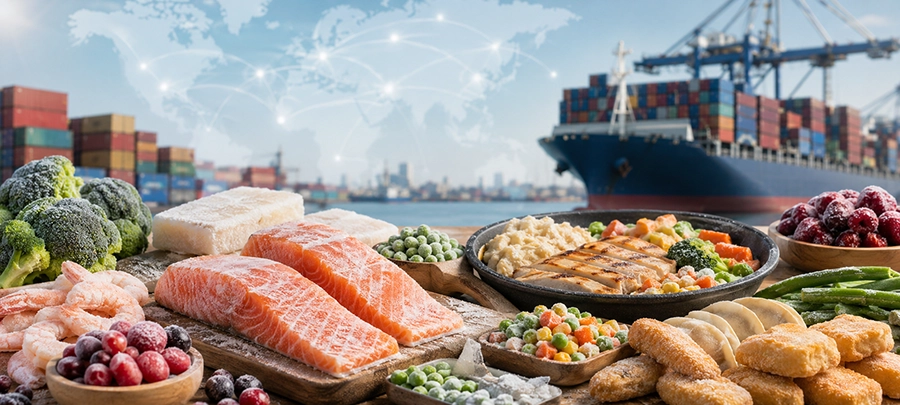
Frozen food has moved far beyond being a basic convenience category. Today, it includes premium ready meals, frozen fruits and vegetables, seafood, meat products, bakery items, desserts, ice cream, ethnic foods, plant-based products, and foodservice solutions. For producers looking to expand internationally, frozen food can be one of the most attractive export categories.
The reasons are clear: consumers want convenience, retailers want products with longer shelf life, foodservice operators need consistency, and importers are constantly looking for reliable suppliers that can maintain quality throughout the cold chain.
The global frozen food market continues to grow. One 2026 industry estimate places the market at USD 325.09 billion in 2025 and projects it to reach USD 508.12 billion by 2034, with Europe holding the largest regional share in 2025. SIAL also identifies the United States, Japan, and Germany among the top frozen food importers globally.
For exporters, the opportunity is not only to sell more products, but to choose the right markets, understand local demand, and find importers with strong frozen logistics and distribution capacity.
Frozen Food in the United States
The United States remains one of the most attractive frozen food markets for exporters.
Frozen food is now a core part of meal planning for many American households. According to the 2026 Power of Frozen in Retail report released by AFFI and FMI, 40% of U.S. shoppers use frozen foods every few days or daily, up from 35% in 2019. The same report found that 30% of consumers plan to buy more frozen food, while 77% purchase frozen foods with a specific meal or day in mind.
This creates opportunities across many categories, including frozen vegetables, fruit, seafood, meat, poultry, ready meals, snacks, bakery products, and ethnic frozen foods.
The U.S. market is competitive, but it is also large and highly segmented. Exporters with differentiated products can still find opportunities, especially if they offer clean-label ingredients, premium quality, authentic ethnic recipes, plant-based options, sustainable packaging, or private-label production.
For many producers, the best approach is not to compete directly with major national brands, but to target specialized importers, ethnic distributors, foodservice suppliers, independent retailers, and premium grocery chains.
Germany
Germany is one of the most important frozen food markets in Europe and a strategic entry point for exporters targeting the wider EU region.
Germany benefits from strong retail infrastructure, high consumer acceptance of frozen products, and a mature network of supermarkets, discounters, wholesalers, and foodservice distributors. Europe held the largest share of the global frozen food market in 2025, while Germany is frequently identified as one of the region’s leading markets.
German buyers often focus on quality, food safety, price competitiveness, packaging efficiency, and reliable supply. This makes Germany attractive for producers of frozen vegetables, frozen bakery, frozen potato products, seafood, meat products, plant-based meals, and private-label ranges.
However, exporters should be prepared for strict requirements. German importers and retailers usually expect full documentation, stable production standards, accurate labeling, and certifications such as IFS, BRCGS, HACCP, organic certification, or other relevant food safety standards depending on the product.
France
France is an interesting frozen food market because consumers are increasingly open to premium frozen products that combine convenience with quality.
Frozen food in France is not only about basic vegetables or low-cost meals. Premium frozen ready meals, desserts, seafood, bakery, and gourmet-style products have a strong place in the market. SIAL highlights the move toward premiumization, sensory innovation, world cuisines, and ultra-convenient formats as major forces shaping frozen food demand.
This makes France attractive for producers that can offer high-quality frozen products with strong taste, attractive presentation, and clear origin. Products inspired by regional cuisine, Mediterranean food, Asian cuisine, premium desserts, frozen seafood, and ready-to-cook meal components may all find opportunities.
The market is competitive, but it rewards quality and differentiation. Exporters should pay close attention to packaging, recipe quality, sustainability claims, and product positioning.
United Kingdom
The United Kingdom remains a mature and valuable market for frozen food exporters.
British consumers are familiar with frozen ready meals, frozen vegetables, frozen desserts, frozen fish, frozen snacks, and private-label products. The market is also shaped by value-seeking behavior, online grocery development, and demand for convenient meal solutions.
Industry analysis points to growth in frozen snacking, international cuisines, and online grocery-led distribution in the UK.
For exporters, this creates opportunities in several directions. Affordable frozen products can appeal to value-focused buyers, while premium or health-positioned products can target more specialized retailers. Ethnic frozen meals, plant-based options, gluten-free products, frozen bakery, frozen seafood, and private-label ranges can be especially relevant.
The UK can also be a good test market for exporters because consumers are open to international cuisines and retailers often seek innovation in private label.
Japan
Japan is one of the most sophisticated frozen food markets in Asia.
Frozen food sales in Japan have been increasing year after year, reaching a record high in 2023. USDA Japan notes several drivers behind this growth, including more time spent at home, a rise in dual-income households, demand for convenience, and ongoing price inflation. The market includes both prepared frozen foods and frozen ingredients such as vegetables and fruits.
Japan is attractive for exporters of frozen vegetables, fruits, seafood, ready meals, snacks, bakery, and portion-controlled products. However, the market requires precision. Japanese importers expect high quality, consistent sizing, excellent packaging, reliable freezing methods, detailed product information, and strong food safety documentation.
Exporters targeting Japan should also consider smaller pack sizes, convenience-focused formats, clean presentation, and products adapted to Japanese consumer expectations.
South Korea
South Korea is one of the most dynamic frozen food markets in Asia.
The South Korean frozen food market was valued at approximately USD 2.21 billion in 2025 and is projected to grow at a 6.70% CAGR through 2035. Growth is being driven by single-person households, convenience demand, modern retail, online delivery, and the popularity of frozen Korean cuisine such as dumplings and gimbap.
The market is attractive for exporters of frozen ready meals, frozen snacks, seafood, meat products, vegetables, and products that work well in e-commerce and convenience retail.
South Korean consumers are highly responsive to trends, packaging, branding, and convenience. Products that are easy to prepare, portion-controlled, premium, health-oriented, or linked to international cuisines may attract strong interest from importers.
Online channels are especially important. Exporters should look for distributors that understand frozen e-commerce, same-day delivery, and specialty retail.
China
China remains one of the largest long-term opportunities for frozen food producers.
The Chinese frozen food market is forecast to grow from USD 35.21 billion in 2025 to USD 78.52 billion by 2034, supported by urbanization, busy lifestyles, demand for ready-to-cook foods, cold-chain improvements, and expanding retail networks.
Demand is strong for frozen dumplings, hotpot ingredients, seafood, meat products, vegetables, ready-to-cook meals, and products suited to online grocery and modern retail.
However, China is also a complex and highly competitive market. Domestic frozen food producers are strong, and local tastes matter. Exporters need a clear reason to enter the market, such as premium quality, food safety reputation, unique origin, specialty ingredients, international cuisine, or products that are difficult to produce locally.
The right importer or local distribution partner is essential, especially for product registration, labeling, retail access, and online sales.
United Arab Emirates
The UAE is an attractive frozen food market because of its import dependence, strong hospitality sector, high purchasing power, and role as a regional distribution hub.
The UAE frozen food market was valued at USD 0.86 billion in 2025 and is expected to reach USD 1.26 billion by 2031. Growth is supported by Dubai’s strong consumer base, Sharjah’s logistics role, and reliance on halal-certified imports.
The UAE offers opportunities for frozen meat, poultry, seafood, vegetables, ready meals, snacks, desserts, bakery products, and premium foodservice products.
Exporters should pay close attention to halal certification, labeling requirements, shelf life, packaging durability, and the ability to maintain quality in a hot climate. Because the UAE also acts as a gateway to other Gulf markets, a good local distributor can potentially open doors to Saudi Arabia, Kuwait, Oman, Bahrain, and Qatar.
Saudi Arabia
Saudi Arabia is another Gulf market with strong potential for frozen food exporters.
The Saudi frozen food market is projected to grow from USD 2.54 billion in 2025 to USD 3.77 billion by 2031, with ready-to-eat products identified as the fastest-growing segment. Growth is supported by urbanization, changing lifestyles, rising disposable incomes, expanding retail, and demand for convenient meals.
Frozen poultry, meat, seafood, snacks, fruits, vegetables, and ready meals are all relevant categories. Online grocery is also becoming more important, while supermarkets and hypermarkets remain key sales channels.
Saudi Arabia is attractive, but exporters need to be prepared for strict import requirements. Halal certification, product registration, labeling, shelf life, and cold-chain reliability are essential.
India
India is a fast-growing but more complex frozen food market.
The Indian frozen foods market was valued at INR 216.59 billion in 2025 and is projected to reach INR 643.64 billion by 2034. Growth is being driven by urbanization, higher disposable incomes, cold-chain development, dual-income households, and quick-commerce platforms. Frozen vegetable snacks were the leading product segment in 2025.
India is especially interesting for frozen vegetable snacks, frozen fruits and vegetables, potato products, frozen meat products, seafood, and ready-to-cook foods.
However, imported frozen food can face price sensitivity, regulatory requirements, and strong local competition. Exporters targeting India should focus on products with clear differentiation, such as premium ingredients, specialty international cuisine, health-oriented products, or foodservice solutions.
Emerging Markets to Watch
Beyond the largest markets, exporters should also watch several fast-developing destinations.
Countries in Central and Eastern Europe, Southeast Asia, Latin America, and the Middle East are seeing improvements in modern retail, freezer availability, cold-chain logistics, and e-commerce. This can create opportunities for exporters before competition becomes too intense.
Markets such as Poland, Romania, Vietnam, Thailand, Mexico, Brazil, Kuwait, Qatar, and Morocco may be attractive depending on the product category.
For example, frozen vegetables, frozen fruit, frozen bakery, frozen seafood, and frozen snacks may perform well in markets where modern retail is expanding. Frozen ready meals and premium products may be more suitable for urban, higher-income markets. Frozen meat and poultry may be especially relevant in import-dependent regions with strong foodservice demand.
Key Frozen Food Trends Importers Are Looking For
Several global trends are shaping the types of frozen products importers want to add to their portfolios.
Convenience and Meal Planning
Frozen food is increasingly used as part of regular meal planning, not only as an emergency option. In the U.S., 77% of shoppers now purchase frozen foods with a specific meal or day in mind, showing that the category is becoming integrated into everyday eating habits.
This supports demand for ready-to-cook meals, frozen vegetables, meal components, frozen proteins, and portion-controlled products.
Premium Frozen Products
Frozen food is moving upmarket. Consumers are looking for restaurant-style meals, better ingredients, international recipes, premium desserts, high-quality seafood, and visually appealing products.
SIAL describes frozen food innovation as increasingly focused on pleasure, sophistication, world cuisines, ultra-convenient formats, taste, nutrition, and sustainability.
This is good news for exporters that can offer more than basic frozen products.
Health and Better-for-You Options
Consumers are paying more attention to nutrition, ingredients, and food quality. Frozen fruit, vegetables, seafood, high-protein meals, low-sodium meals, gluten-free products, plant-based options, and clean-label recipes can all benefit from this trend.
In the U.S., 96% of shoppers believe the frozen food aisle has better-for-you options, which shows how much consumer perception has changed.
Food Waste Reduction
Frozen food has a strong advantage because it extends shelf life and helps consumers reduce waste. This is becoming important for households, retailers, and foodservice operators.
AFFI reports that 37% of U.S. consumers use frozen food specifically as a way to reduce food waste.
Exporters can use this in their positioning, especially for frozen fruit, vegetables, bakery, and portion-controlled meal solutions.
E-commerce and Quick Delivery
Online grocery and quick-commerce platforms are changing the way frozen food is sold. This is especially visible in markets such as South Korea, India, China, the UK, and the Gulf.
Frozen food producers should think about packaging that works for delivery, clear cooking instructions, strong product photography, and formats suitable for online retail.
Private Label
Private label is an important opportunity in many frozen food markets. Retailers often look for producers that can manufacture frozen vegetables, ready meals, bakery, snacks, seafood, desserts, or plant-based items under their own brands.
For producers with strong manufacturing capacity but limited brand recognition abroad, private label can be one of the fastest ways to enter new markets.
What Importers Expect from Frozen Food Suppliers
Finding demand is only the first step. Frozen food importers are usually very selective because product quality depends on cold-chain control from factory to final customer.
Before approaching buyers, exporters should prepare:
- product specifications
- shelf life and storage temperature
- freezing method, such as IQF, blast frozen, or block frozen
- packaging details
- pallet configuration
- production capacity
- certifications
- nutritional information
- ingredient list
- allergen statement
- labeling options
- sample shipment procedure
- pricing by volume
- minimum order quantity
- logistics and shipping conditions
For many markets, certifications such as HACCP, BRCGS, IFS, ISO 22000, organic, halal, kosher, MSC, ASC, or GlobalG.A.P. can make a major difference depending on the product.
Importers also want reliability. Frozen food buyers need suppliers that can deliver consistent quality, avoid temperature breaks, maintain documentation, and support long-term supply.
Finding Frozen Food Importers and Distributors
Choosing the right market is important, but finding the right importer is what turns market potential into sales.
Frozen food producers should look for importers that already handle temperature-controlled products and have access to the right sales channels. These may include:
- frozen food importers
- supermarket suppliers
- foodservice distributors
- seafood importers
- meat and poultry distributors
- fruit and vegetable importers
- ethnic food distributors
- private-label buyers
- online grocery suppliers
- wholesalers serving hotels, restaurants, and catering companies
BestFoodImporters offers a dedicated Frozen Food & Ready Made Meals Importers database with over 13,000 frozen food importers, distributors, and wholesalers from 200 countries. The category covers frozen fruits, vegetables, meat, fish, seafood, desserts, ice cream, and related products.
For exporters, this type of buyer discovery can reduce the time required to enter a new market. Instead of searching manually for distributors in each country, producers can identify companies already active in the frozen food category and approach them with a targeted offer.
Conclusion
Frozen food will remain one of the most attractive categories for food exporters in 2027.
Demand is being driven by convenience, premiumization, foodservice needs, e-commerce, cold-chain development, and changing consumer lifestyles. The most promising opportunities can be found in mature markets such as the United States, Germany, France, the UK, and Japan, as well as fast-growing markets such as South Korea, China, the UAE, Saudi Arabia, and India.
However, success in frozen food exports depends on more than choosing a country. Producers need the right product positioning, certifications, cold-chain reliability, and importer relationships. The best opportunities will go to exporters that can combine strong products with qualified buyers in the right markets, buyers which can be provided by BestFoodImporters.
